Another week has passed and it’s Wordy Wednesday again. My word for today is flabbergasted, for no other reason than I like it.
According to my Oxford English Dictionary, the word comes from the late 18th century; of unknown origin. Its meaning is to surprise (someone) greatly. An example of usage might be I was utterly flabbergasted to win the prize.
Comedian Frankie Howerd was known for mixing the word up – never has my flabber been so gasted.
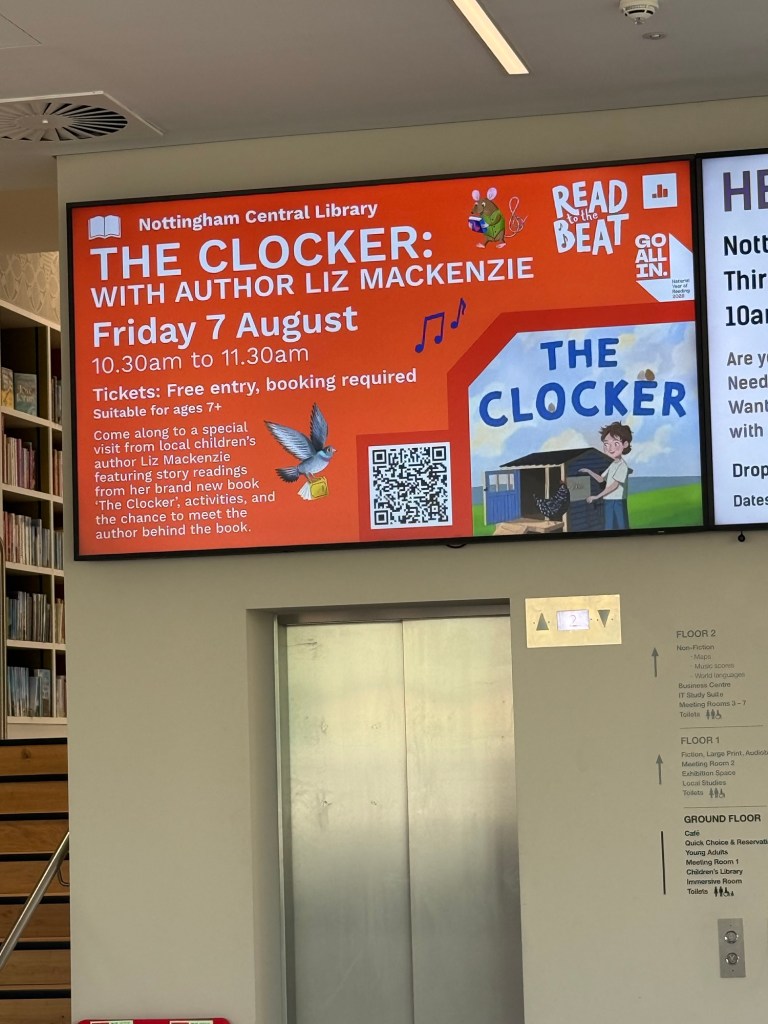
I was flabbergasted to see my name up on a large screen when I went to do my first library event My Books
Share something you’ve achieved, or are pleased with, this week. It doesn’t matter how big or small; go ahead and flaunt it.
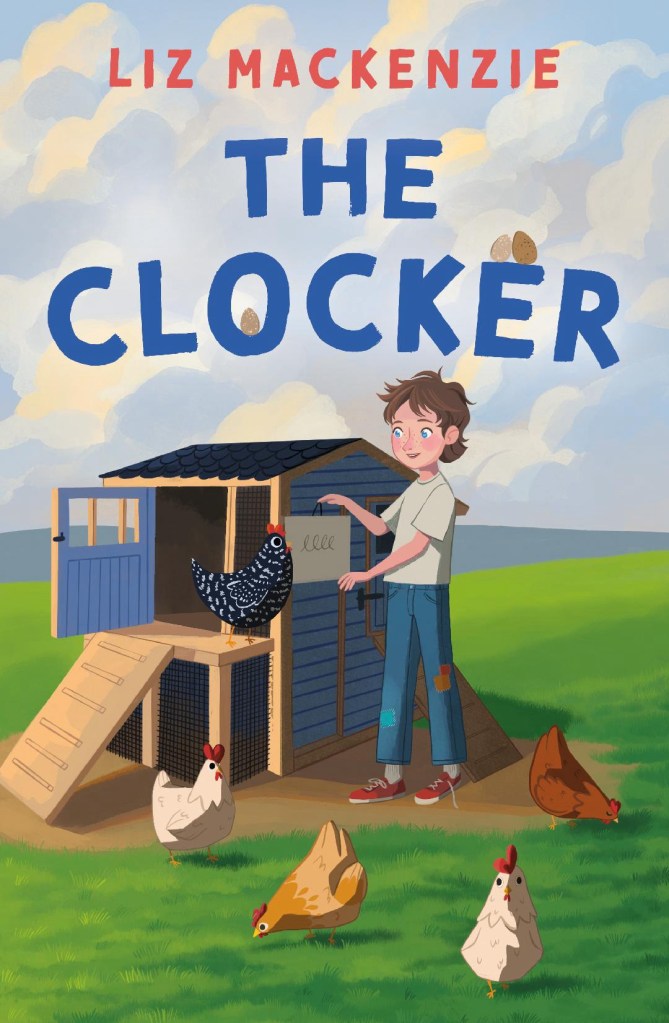
In the last week, I have taken my children’s book, The Clocker, to two local libraries. I’ve met lots of children and their families and had a wonderful time. Each session has started with me reading a few chapters of my book, followed by a writing/ craft session. I’ve been very impressed at how many children know what a blurb is and where to find it on a book.
Each child, as well as some of their family members, thought of an animal whether real or imaginary they’d like to write a book about. They came up with titles, drew pictures and wrote a mini blurb. What fantastic ideas they had, from Superflea, to The Finx, from Flight (about a bird called Blue Bell), to Fun Facts About Snakes. There’s definitely some budding talent out there.
Thank you to Nottingham Central Library and Wollaton Library for inviting me; I loved it.
This is the first thing I saw when I arrived at Nottingham Central Library My Books
Recently, while I wait to get an accurate prescription for glasses following cataract surgery, I have been listening to audiobooks rather than reading. I started off with a book of Agatha Christie short stories, which I really enjoyed. The word countenance has appeared several times, for example she had a pleasant countenance. It struck me that this word is little used today but I felt it worthy of a Wordy Wednesday.
It is another word with several distinct meanings; the first as above, to describe a person’s appearance. Other meanings are to support, she gave her countenance to the event. It also describes when we do not accept or tolerate something, for example she wouldn’t countenance such behaviour.
Originating from the 13th century, the word is from the Old French, contenance referring to bearing or behaviour, from contenir (contain).
This week, I’m going to hand over to Nev, the main character from my children’s book, The Clocker. Nev likes to make up his own words and he’s going to share one of them.
I love making up words. Sometimes there isn’t one that exists that says what you want. I started making up words when I was little. It made people laugh so I made up more. The first made up word in The Clocker is ‘slumpfolded’. It means you’re slumped and folded over all at once. It described how my dad looked when my mum had left us. Apparently, that word also means something to do with a geographical feature but I think my meaning is better.
Have you ever made up a word, either by adding two words together or creating your own word? I’d love to hear them (and so would Nev).
In the morning, as I enjoy my second cup of tea, I like to do a selection of word games on the NYT games app. This generally starts with Connections, followed on by Wordle. A few weeks back I struggled to find letters that would go with the ones I’d got right in Wordle and resorted to random choices. Having nearly exhausted the possibilities, I put in ‘maven’ and it was correct. Not being familiar with the word, I headed to my trusty dictionary. Here I discovered that a maven is an expert, a connoisseur with extensive knowledge in a particular area, for example a fashion maven. The word’s origin is from the Yiddish, mevyn which in turn comes from Hebrew mevin, meaning to understand.
Second cup of tea of the day
In my children’s book, The Clocker, Nev gets embarrassed by his dad using out of date slang words. My Books
Whether you love or hate sport, you’d be hard pressed not to have noticed that both Wimbledon and the football World Cup are currently playing. With that in mind, I have two words this week.
In tennis, the word love relates not to romantic love but a score of zero – she was 15-love down. According to the Oxford English Dictionary, the origin comes from play for love, that is for the love of the game. Folk etymology also links the word with the French, l’oeuf, referring to a similarity in shape to an egg and a zero.
Moving on to football, I do enjoy seeing all the strips from different countries playing in The World Cup. This made me wonder why it’s called a strip, meaning the identifying kit worn by members of a sports team. The Oxford English Dictionary says this possibly comes from the idea of the clothes that players strip down to.
Ready to watch the football
Did you know that, in my children’s book, The Clocker, the main character makes up his own words? My Books
I was on the bus recently (great place to pick up story ideas) and the two people behind me were chatting about a man they both knew. They were speculating as to whether he was ever going to find a partner.
“I wouldn’t ask, if I were you,” one said. “He takes umbrage at personal questions, that one.”
I smiled as they got off the bus, thinking there’s my next Wordy Wednesday.
To take umbrage means to be upset or offended by something someone says or does. I hadn’t thought about the meaning as it relates to providing shade, coming from the Old French umbrage. This in turn is from the Latin umbrâticus, which relates to shade – umbra shade. (Collins Dictionary)





 mywordshare